


Living as a Resident Stranger
- Nov 18, 2025
- 3 min read
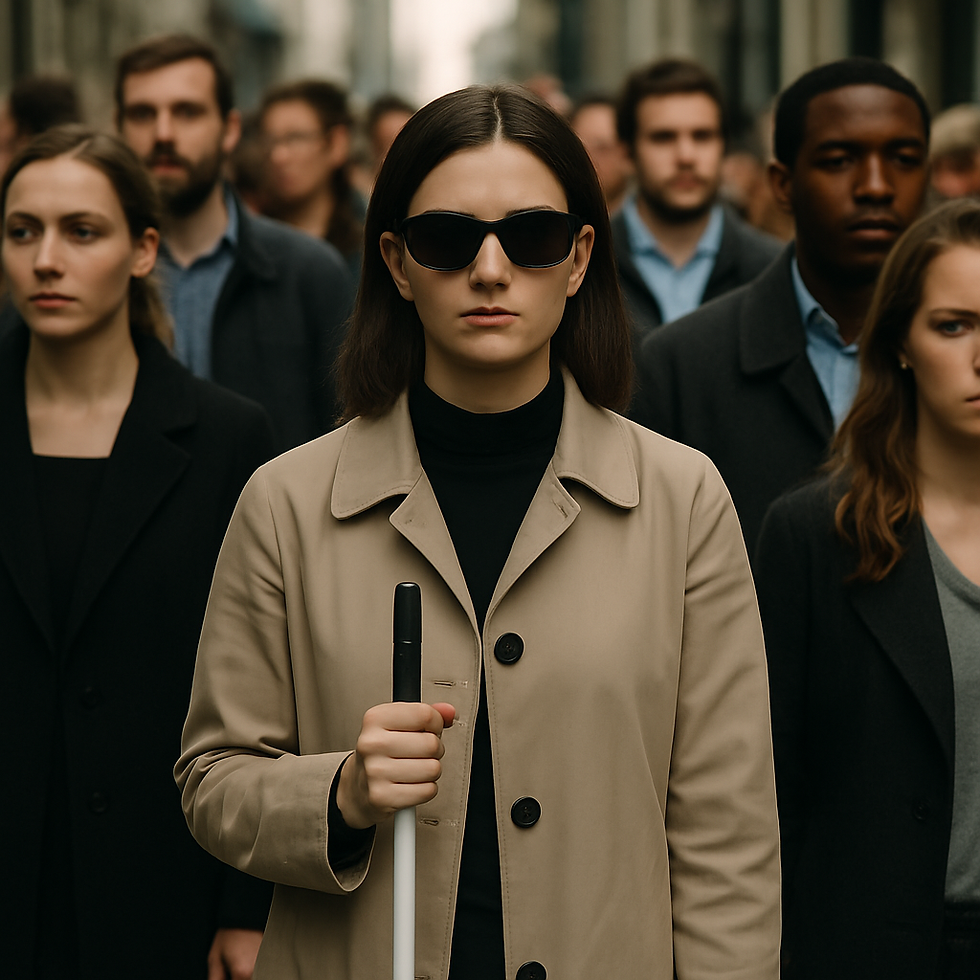
I was recently reading about the biblical concept of a ger toshav—the “resident stranger.” In the Torah (Leviticus 25:35–47; Deuteronomy 14:21), a ger toshav was someone who lived among the Jewish people, followed their moral laws, and was protected and respected, but was not fully part of the covenantal community. They lived with the people, but not entirely of them—inside and outside at the same time, present and accepted but still set apart.
That image—living among, but still set apart—resonated with me. Because in many ways, that is what it feels like to live as a blind woman in a sighted world.
I am often welcomed. People are kind; they open doors, offer seats. But being welcome into a space is not the same as belonging. I can feel the difference in my core—the subtle gap between being invited in and being expected there. Every day, I’m reminded that the world’s design and rhythm weren’t built with me in mind. That gap shows up everywhere—not just in infrastructure or code, but in human habits.
I sit in meetings where PowerPoint slides flash across a screen I can’t see, or handouts are passed around that I can’t read. No one thought to ask, in advance, if I’d need them in an accessible format—or even if I might need accommodations at all. I arrive, but even when I’m expected, I’m not quite anticipated—a subtle distinction.
These moments don’t come from unkindness. They come from a world that assumes sight as the default setting—a design that welcomes me kindly but forgets to include me structurally. My belonging depends not on assumption, but on someone’s willingness to make room.
Like the ger toshav, I live here. I contribute. I follow the laws and rhythms of the land. But the covenant—the design that binds most people effortlessly to the world around them—was written without me in mind.
Being a blind person in sighted spaces requires a constant kind of translation. I am always interpreting the visual world into something tactile, auditory, or conceptual. That translation isn’t just practical; it’s emotional. It’s the labor of moving through spaces that are not meant for you, and doing it gracefully enough that others don’t see the strain. There’s a quiet loneliness that comes from that—not necessarily from being alone, but from being perpetually adjacent to full participation. Even in the most inclusive settings, there’s that inner awareness: I’m welcome here, but I wasn’t planned for here.
There’s a difference between hospitality and home. Hospitality says, “We are happy for your visit.” Home says, “This is yours too, and we are prepared.” The ger toshav was treated with hospitality; the Torah commands compassion and justice toward the stranger living among you. But the ger toshav still lived in someone else’s system, dependent on goodwill rather than shared design. That distinction feels familiar when I think about disability and inclusion. So much of what we call accessibility is really hospitality—ramps added to existing steps, captions added to existing videos, exceptions made to existing rules.
But belonging means more than access. It asks us to imagine a world built from the beginning for many ways of being human—a world where difference isn’t a guest but a resident.
People learn to see differently when they move through the world with me. I learn to trust, to articulate, to advocate, and to forgive the world its limited imagination.
Living as a resident stranger sharpens the soul. It teaches empathy for anyone whose existence doesn’t fit neatly into the world’s default settings. But still, I long for more than grace. I long for redesign.
If hospitality is about welcome, and home is about belonging, then covenant is about shared commitment. What would it mean to build a world where disabled people aren’t just accommodated, but covenanted into its design—where we are co-authors, not afterthoughts? It would mean cities that speak as well as they shine, technology that assumes multiple senses, communities that prize interdependence over independence. It would mean recognizing that accessibility isn’t charity—it’s culture.
That’s the world I want to help build: a world not of strangers, but of neighbors. A world where the ger toshav becomes simply another person at home in the heart of humanity.
I belong to this world. I love it. But it’s not yet built for me. And until it is, I will keep finding ways to live meaningfully within it—as a stranger, a neighbor, a builder, and a believer that true belonging is still possible.
Perhaps that’s what faith is: to live as a resident stranger, and still believe that one day, the world will be rebuilt with everyone in mind.
Written By Michelle Friedman
Michelle Friedman is the board chair of Keshet in Chicago, a member of Disability Lead and has been a disability advocate for 40 years. She has written two children’s books and is a frequent speaker for elementary and high school-age students. #AllInForAllAbilities


Comments